Wednesday, June 24, 2015

OLD SHOTGUN FACINATION

What is wrong with me?  I have this thing for old shotguns.  Old, used, nicked up, and just plain beat; I do love them.  What draws a person to an old war horse with no bluing, 2-3/4 chamber, and a full choke worthless for modern waterfowl loads?  I don't know the exact reasoning, but I'd say it has to do with time travel.  Old things take me back to the time that they were made or used.  It's easy to forget how much things have changed in 50-100 years, but things were very different not so long ago.


When I pickup an old shotgun, I imagine a group of hunters out on a cold fall day hunting the abundant ducks on the Illinois River.  Or maybe a Father out hunting rabbits for the first time with his kids.

The rusty metal, the poly chokes, splits in the wood, all that turns most people off, but to me, they are more desirable than a new Benneli in full camo with a 3-1/2 inch chamber.  Sure that new Benneli is an awesome gun, but it has no history.  And history is 1/2 the reason I shoot.


I find it entertaining just to shop the used guns at my local shop.  I find so much neat old stuff.  16 gauges are always in good supply, since no one seems to shoot them anymore.  Old pump guns from Montgomery Ward, JC Penney, Sears.  Ah the glory of the department store shotgun.


Did I mention these guns are cheap?  Yes, very cheap.  It seems the shotgunning world places a premium on newness more that the rifle or pistol world.  My local shops have perfectly good pump guns for $150 $225 all day long.  And older guns tend to be built nicer in my opinion.  Walnut wood and good steel is always a plus to me, even if it does need refinishing.


Friday, June 12, 2015

LEE LOAD-ALL SHOTSHELL RELOADER

  The Lee Load-All is an economical shotshell reloader made for 12,20, and 16 gauge shells.  They are sold in a specific gauge (ie 12 gauge), but can be converted to another gauge once you have bought the loader.  Lee products have long been a favorite of mine.  They build a better mousetrap, dispense with the B.S., and make things affordable.  Lee has marketed it as the Load-All II for many years.  It's the same loader, it's just that more plastic is used these days.

Conversion kits change the load-all to another caliber
The traditional shotshell loaders made by MEC, Texan, etc, are quite pricey and don't include all the bushings you might need.  Those bushings aren't cheap if you buy a bunch of them.  Lee chose to make most of the Load-All out of plastic, including the bushings.  This reduces cost of manufacture, while still being strong enough to make plenty of shells.

I bought my first one around 1999.  I used the heck out of it and could not break it.  I gave it to my nephew when I took a hiatus from shooting, but bought a used one a few years back.  It was missing a few small parts, but Lee services pretty much everything they sell right down to the screws that hold it together.  Gotta love Lee.

Some people debate the usefulness of such a tool when you can walk into Wal Mart and buy a box of shells for around $6.50.  I shoot plenty of loaded shells.  But, I like the ability to doctor up shells of my liking.  If I want to load 1 ounce of 6 shot with a light powder charge, I can do it.


It's also important to understand that the price of shotgun shells goes way up once you get away from the promotional loads.  You may be able to buy promo loads for cheap, but they are only useful for
shooting clays and upland birds.  If you are going after turkeys or any other game where larger shot/heavier loads are necessary, you will pay a lot more than $6.50 for a box of shells.  In that case, having the ability to load your own is a real wallet saver.

The small manual that comes with the loader is full of valuable information.  Lee dispenses with a lot of the myth and hearsay and really makes loading easy.

I have loaded just about every 12 gauge shell I have ever come across on the range.  Some just don't load well.  But some load great.  Conventional wisdom says that only Winchester AA shells should be reloaded.  I used to use AA shells quite a bit, but I found that there were other options.  Remington STS shells are another excellent choice.  They are very similar to the AA, but have a slightly longer case length and make nicer crimps.  Lately I have become a fan of Federal promo hulls for reloading.  They make nice crimps and are very plentiful.

It is the crimp that is the tricky part.  And, that all boils down to getting a shot load, wad, and shell that like each other.  If there is too much shot protruding from the wad, the crimp won't close and you will end up buckling the shell.  Too little shot and the crimp just falls in and all your shot falls out.  Neither is a good situation.  Basically find a combination that works well for you and stick with it.

I have found a trick to help if the crimp falls in.  I was adding just a little more shot to the shell before crimping, but that uses expensive shot and adds significant weight to your payload.  In other words, if I'm loading 1 ounce shells and end up adding 1/8 ounce of shot to the shell just to make the crimp right, I'm no longer loading 1 ounce shells am I?  Adding a light weight filler, such as ground walnut shells right before I load the shot takes up the space but does not add significant weight or use up my costly shot.  You could use ground up paper, plastic, or anything you choose.  Shell manufacturers often buffer heavy loads anyhow, so it's not like I am advocating anything new.

The Load-All is no match for a MEC or similar loader in terms of quality of feel.  But the average shotgunner that just wants the ability to make his own shells really doesn't need more than the Load-All.  If you are at all interested in loading shotshells, get one.

Brass sizer collar can be used to resize the "brass" part of the shell.  This slows the process down just a bit.

Older units had cast metal bases

The primer feed device is optional.  I have never had one.

Tuesday, June 9, 2015

MARLIN 795

The Marlin 795 is a semi automatic .22 caliber rimfire rifle chambered for .22 long rifle.  It is an adaptation of the model 60 and its predecessors.  The big difference between the two is that the 795 uses a detachable box magazine whereas the 60 uses a tube magazine.  The 795 is currently sporting an 18 inch barrel and the 60 uses a 19 inch, no doubt to maintain the length of the magazine tube.


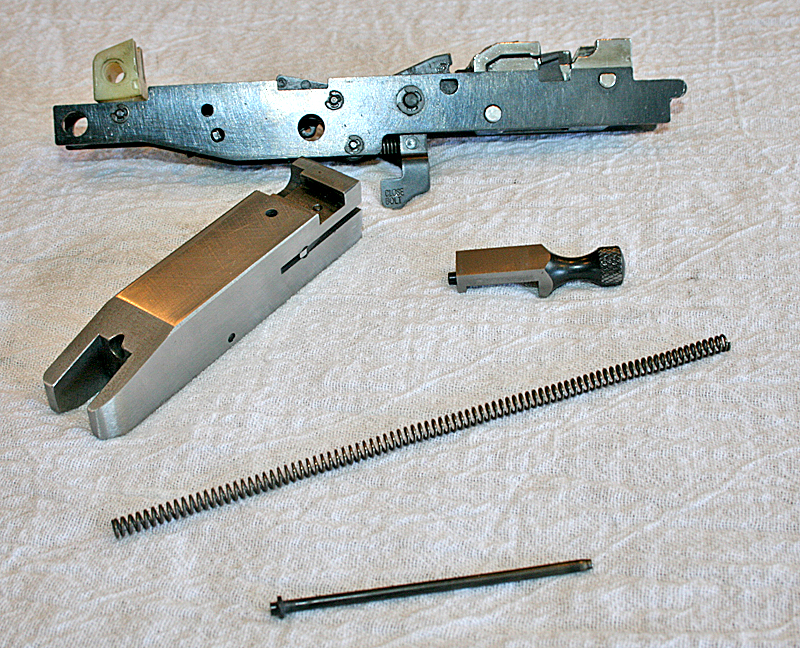
It all starts with a light alloy receiver that is completely open on the bottom.  The bolt is heavy steel and contains the firing pin and two extractors. Always nice to have two.  The recoil spring fits into a slot in the bolt and over a guide rod that fits into a slot in the receiver.  This is my only complaint about the gun.  Getting the bolt into the receiver without either bending the spring or shooting the guide rod across the room takes practice.  Other than that, take down for cleaning is a cinch.

The barrel is a fat, nearly bull, barrel with a tapper near the end.  No skinny, pencil barrel crap here.

A really great feature is the last shot hold open.  This guarantees you won't inadvertently dry fire the rifle, something that should be avoided with rimfires.  There is a difference in recoil on the last shot, just like an auto pistol.  Simply swap out the magazine, hit the bolt release, and fire away.  Why aren't they all like that?  Everywhere I look, I see neat features that I did not expect.


I had dismissed the 795 as just another cheep .22.  That was my mistake.  Quality wise, the 795 is above the crowd.  Fit and finish is great, considering the $159.00 price tag.  It is well engineered and well built.  I would put it on par with the 10-22 for much less cost.  All plastic parts are well made and do not give me the impression that they will snap anytime soon.

Simple and robust

One interesting thing is that the 795 is not available with a wood stock.  That's a shame, but the synthetic stock is quite well made.  It is glass reinforced and fits the rifle like a glove.  It sure beats the hell out of the plastic stock on my Savage 62.

Micro groove rifling is another feature that sets the 795 apart.  Marlin has long touted it micro groove barrels as superior in accuracy.  By most accounts, the 795 is very accurate.  Basically micro groove uses more grooves, but cut shallower.  Theory is that there is less drag on the bullet.  I don't know how much better it works.  All I know is the rifle hits what I aim it at.

One addition that I will be putting on it is the tech sights.  I've fallen in love with the sight picture on service rifles.  Since I cannot afford an M1 Garand, carbine, or  an AR, this will become my little carbine.


My initial shooting impression was very impressive.  I first ran American Eagle copper plated hollow points, which ran flawlessly.  Next, I tried some Remington Thunderbolts.  No issues.  Ok, so I really wanted this thing to jam.  On to the golden bullets by Remington.  Again, pop pop pop, no problems.  The only thing that would cause a failure to feed were Federal automatch, ironically.  For a new 22 to perform that well is impressive to me.  My Brother said that his 795 had a very rough feed ramp that he had to smooth out.  Mine was quite smooth, so I left it alone.  Again, attention to detail that I never expected from an under $200 gun.  Kudos to Remington for keeping this gun in production and keeping quality standards high.  Yes, Marlin is now part of freedom group.  I can't say that I am in favor of all these gun makers being absorbed by one big conglomerate, but I guess that is the way of the world.
Boyds Evolution SS Stock

Do I recommend the 795?  You bet.  It is way more than some cheap .22.  It is well engineered and well built.  With all the features on this little rifle they could charge more.  I'm glad they don't.

Wednesday, May 6, 2015

Head Space

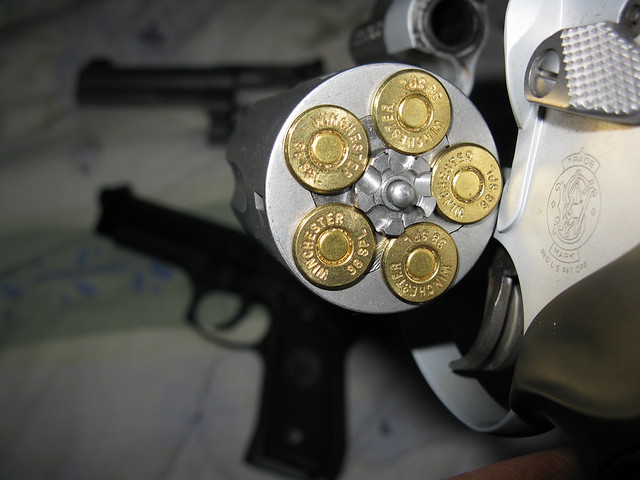
Revolvers are typically chambered for rimmed cartridges.


All breech loading guns have something known as head space.  It is best illustrated in terms of a bolt action rifle.  When a cartridge is placed into the gun's chamber, The bolt face (where the firing pin comes through) must seat tightly against the head of the cartridge (where the primer is).  If it doesn't seat tight, the cartridge head will expand and fill this void.  This not only ruins the brass, but can lead to a dangerous release of gas pressure.  This would be known as excessive head space. If there is not enough head space, the bolt simply will not close.

You may also hear about a cartridge "head-spacing" on the rim or on the case mouth etc.

When a cartridge is loaded into a gun's chamber there is something that "parks"
it at a certain place.  There are 3 different ways this happens.


1.)    Rimmed cartridge:  Some cartridges have a distinct rim at the base.  Think .38 special, 44 mag, or 30-30.  These cartridges are held in place by the rim.  Think about putting a life preserver around your waist and jumping into a small well hole.  Your legs will fit into the hole but that preserver around your waist stops you from falling all the way through.  Because the cartridge "head spaces" on the rim case length is not critically important.  So long as the overall length of your finished cartridge is correct, it really doesn't matter if the case length is a little short.

The cartridge on the left is rimmed, at right is rimless


2.)    Rimless auto loading cartridge:  Think .45 acp, 9mm Luger, .380 acp etc.  Most cartridges designed for auto pistols are of a rimless design.   They do not have a rim to head space on so they head space on the case mouth.  This makes case length in an auto pistol cartridge more critical.  Too much case length and the gun will not go into battery.  ie the slide will not go fully closed and any breech locking mechanism may not lock.  Some guns will not fire in this condition, some will.  Not a good situation either way.

Too short a case can also cause some feeding and extraction issues,  It should also be noted that crimping any auto cartridge is undesirable for the same reasons.  I used to crimp my Makarov cases just because.  I never did have any feed issues, but upon examination, I could tell that the case was trying to stick in the chamber.  I haven't crimped one since.

These Mauser rounds head space on the case shoulder.

3.)    Bottleneck cartridges:  Most center fire rifle cartridges do not head space on the case mouth or the rim.  These bottleneck cartridges head space on the case shoulder.  The chamber of the gun is reamed to fit the cartridge.  When the cartridge enters the chamber, it stops when the shoulder meets the corresponding bevel cut into the chamber.  That said, case length still must be observed.  Cases exceeding the recommended length may prevent the bolt from closing.


4.)  Belted cases:  These are the odd balls.  They basically use the same theory as the rimmed case, but with the added strength of a wide belt rather than just a thin rim.  Belted cases, such as the 300 win mag, are also bottle necked with a shoulder, so they can use the belt or the shoulder or both to head space.

300 Win Mag showing the belt at the base

Friday, April 24, 2015

THE .410 - WHY AND WHY NOT

It's a good bet that any shooter you ask will tell you the first gun they ever shot was either a .22 rim fire or a .410 shotgun.  The two things these guns have in common is their relatively low recoil.  The .22 has almost no recoil and can be extremely accurate, so it makes perfect sense for the new shooter.  The .410 however is likely chosen only for it's light weight and low recoil (in terms of shotguns).

While recoil is a good thing to avoid with new shooters, it's also advisable to let the new shooter hit something, lest they get discouraged and give up the sport.  Therein lies the issue with the .410.  The small shot payload of 1/2 ounce in a 2.5" shell just isn't a lot of lead.  Even the 3 inch shells only carry 11/16 of an ounce.  To maximize the killing power of these small shot charges gun makers build nearly all .410 guns with a full choke, keeping patterns tight.  Tight yes, but small too, making it difficult to hit flying targets.  This is why you often hear the .410 termed an "experts gun".  It's the hardest to hit with.


My suggestion on introducing shooters to shotgunning is to allow them to use the .410 on stationary targets on the ground.  Combine this practice with some time patterning the gun on a large piece of cardboard to get a feel for where the gun shoots and just how small the pattern is.  Then turn them loose on slower moving close in birds if possible.  That way they have some idea of how the gun feels and what happens to the shot after it leaves the barrel.  These close, slow, birds will still teach the concept of lead, but increase the chance of hitting with the .410.  Of course, a 28 gauge is a better option, but fewer of us own a 28 than a .410.  So, use what you have.

There are other reasons to shoot a .410 other than teaching new shooters.  Experienced shooters often like to "handicap" themselves by shooting the little gun.  Theory being, If I can hit birds with the .410, I can surly do it with a larger gun.

Hunters have a mixed history with the .410 bore.  Some shun it as a kid's gun, but it can be more appropriate for certain game than larger gauge guns.  Do you really need to blast a rabbit or a squirrel with a 12 gauge?  The .410 with it's modest payload and super tight pattern allows for clean head shots on small game without scattering the rest of the animal with shot.


It's the self defense role that has caused a resurgence in the .410 lately.  With the advent of the Taurus Judge and S&W Governor, suddenly everyone was interested in .410 shells.  This has flooded the market with all sorts of ammo designed with defense in mind.  Some of these shells are quite nasty. Winchester's PDX loads combine buckshot with lead discs that resemble throat lozenges.

You name it, someone is probably stuffing it into a .410 shell and selling it.  I have to say, I'm not big on exotic ammo for self defense.  It's enough to stop the threat with buckshot or #4 without hitting them and maybe a bystander with two balls and a wire or a pack of damn razor blades.  Cool to play with, but I would personally not carry any of the weird ammo if I had a .410 CC revolver.


My nephew used to swear by .410 slugs.  He used them on coons that would come around getting after his dogs.  According to him, the slugs really split them wide open.  The 1/4 ounce slug is not appropriate for deer, but is useful on coyotes, raccoon, and such. Full chokes may have an adverse effect on accuracy.

http://mcb-homis.com/slug_410/

Large buckshot like 00, is available,  but the shell can only fit like 3 00 balls, so it's usefulness is debatable.  Smaller shot, like 3 buck or 4 buck is probably more appropriate for the gauge.


So, the .410 shotgun has been around for over 100 years and is not likely to go away anytime soon.  It is an enigma.  Soft shooting, but hard to hit with.  What is it worth?  I personally find it fun if used within its limitations.  It's when people try to make the .410 do a 12 gauge job that they run into trouble.

Thursday, March 26, 2015

THE .32 SMITH AND WESSON


In 1878, Smith and Wesson introduced the
Model No. 1 1/2 Single Action Revolver and with it the .32 S&W cartridge. The .32 S&W is a straight walled, rimmed, center fire cartridge that was originally loaded with black powder. It has been loaded with smokeless powder for at least 70 years now.


The .32 S&W should not be confused with the .32 S&W Long, which is simply a longer case loaded with more powder and generally the same bullet.

In fact, the original .32 S&W is sometimes referred to as the .32 S&W short.


My affiliation with this obsolete round comes from the Iver Johnson safety revolver that I purchased for my Dad a few years back. We purchased several boxes of magtech factory ammo for it. Our gun is a later production item in good shape, so I was not too concerned with it blowing up in my face. That said, the magtech does seem to be a little on the hot side. Some of that might be the 85 grain bullet as opposed to the 78 grain I currently load. The heavier the bullet, the stiffer the recoil.

  I have been loading the magtech brass topped with a 78 grain rim rock rn bullet over 1.6 grains of Unique. That load is good for right around 400 FPS over my crony. Not fast no, but plenty accurate and easy on the gun. Yes it is possible to hit something with one of those guns. I am currently working up a load using titegroup. I recently bought a chamber adapter for my Mosin Nagant that allows the use of .32 pistol ammo in the old battle rifle. That allows me to work up a load safely in a chamber designed for much higher pressures. Even if I overload it to the extreme, the gun is more than capable of handling the pressure. Once the fps is comparable to the Unique load, I can load it into the 100 year old revolver with some confidence. Loading these little jems is such fun. The magtech brass has held up very well. The only downside is the light powder charges. My powder thrower just won't dispense that low of a charge and powder dippers can be unreliable at that small a charge.


Modern day carry guns can provide much more powerful cartridges in a package about the same size as the old .32 revolvers. So the case for carrying one of the old antiques is just not there. And there goes the case for the .32 S&W as a modern defensive round. Though, that is exactly what it was intended for. And really, compared to the .25 acp or .22 lr, it is a better round. Both of those rounds see plenty of use in carry guns today, though they both produce less energy than the old .32.

It was the .32 S&W that took the life of President McKinley in 1901, though the 2 bullets that struck him did not cause his immediate death.


Tuesday, March 3, 2015

All about Bullets

Bullets, aka projectiles, are the thing that exits the barrel of a gun and impacts the target.  A lot goes into getting that bullet to get to the target, but this article will concentrate on the bullet itself and the different designs and materials.

Early Bullets, prior to the American civil war thereabouts, were typically soft lead.  That is they were basically pure lead or an alloy that was just slightly harder than pure lead.  That was ok because the large caliber bullets used in early guns were not intended to be loaded to anything over maybe 1000 feet per second.  At those low velocities and large bore sizes soft alloys worked just fine.  In fact the mini ball of civil war fame relied on the soft lead alloy to function.  As the black powder burned under the bullet, the hollow base expanded and sealed the bore from the gasses.  


At the end of the 19th century an absolute revolution in small arms ammunition occurred.  Black powder, which had been the only powder since the invention of the gun, was replaced by smokeless powders which are made from nitroglycerin, nitrocellulose, or a combination of both.  Along with this change in powder came changes in cartridge design.  Metallic cartridges had now replaced muzzle loading and other tedious loading procedures.  The self contained metallic cartridge was at first used with the same old black powder.  When they started loading them with smokeless, it was a marriage made in heaven.  


Black powder could only create so much pressure, so therefore the bullets used with it were rather large.  Big bullets traveling slowly (600-1000 fps)  do a lot of damage.  But with smokeless powders you can create great pressures and do the same damage with a smaller bullet.  Instead of a .50 caliber bullet doing say 600 fps.  You now had a .30 caliber doing 2000 fps.  The problem became that lead bullets just could not with stand the speeds they were being propelled at. Enter the jacketed bullet.  We'll learn more about that later.

Here is the low down.

Alloy is the term used to describe a mixture of metals.  Pure lead is very dense and works well in low speed antique applications.  However it just does not perform in smaller, faster applications.  leading of the bore is one issue.  One way to avoid the inherent problems of lead bullets is to mix the lead with other metals to make an alloy that is harder than pure lead.  These bullets are often termed "hard cast" bullets.  Metals like antimony and tin are added to the lead.  The resulting alloy is much harder than lead and perform well up to a point.  Unlike pure lead there is little or no deformation or expansion when hard cast bullets strike a target.  Like lead bullets, hard cast bullets need to be lubricated and as such will have grease groves to hold lubricant.

  Hard cast bullets work well in pistols of all types as well as rifles, so long as they are loaded to an appropriate speed.  Cast bullet loads often use powders designed for pistol and shotgun work.  One way of getting more speed out of a cast bullet is the use of a gas check.  Simply put, gas checks are copper or other soft metal attached to the bottom of a cast bullet that resist the burning powder's heat and pressure.  
Image result for gas check

Most modern factory bullets are of the jacketed variety.  Indeed, you just can't push cast bullets at the velocities developed in modern rifle loads, weather gas checked or not.  Jacketed bullets are made differently than cast bullets.  The jacket is usually made of copper.  Think of it as a gas check that covers the whole bullet.  What we see is actually just the jacket.  The lead is inside.  It is not cast, but cut from a roll of soft lead wire and inserted in the copper jacket.  Here are some terms you need to know.

Full metal jacket.  The jacket encloses the entire bullet.  These may or may not have an exposed lead base, but the sides and top of the bullet are enclosed in copper.
Hollow point.  These bullets have a cavity at the top which cause the bullet to expand when the target is impacted.  This design stops over penetration.
Image result for hollow point bullets

Soft point bullets have an exposed soft lead tip that deforms and mushrooms upon impact.  Like a hollow point, they aim to stop over penetration and deliver the kinetic energy to the target.
Image result for soft point bullet
Image result for hard cast bulletsAs you have probably noticed, bullets come in all shapes and sizes.  Flat point, spire point, wad cutter, semi wad cutter.  The nomenclature can be confusing.  All designs have a purpose.  Some are appropriate for pistols but not rifles, Some are great for varmints, some self defense.  Some are for big game.  It all depends on what you are shooting it out of and what you are shooting at.  I've included some pictures of different bullet designs.


Image result for wadcutter