Friday, July 17, 2015

Chinese Type 53 carbine Mosin Nagant

The Mosin Nagant is without a doubt the most popular surplus rifle on the market today.  While prices have gone up over the years, they are still an awesome value.  Most of the Mosins out there are standard 91/30 full length rifles.  These were built in the Former Soviet Union by the millions and stockpiled just about everywhere they had influence.  Among the 91/30s, you will also find the occasional M44 Carbine.  These short rifles are essentially a 91/30 with a shorter barrel and a permanently fixed, folding bayonet.
In 1953 the People's republic of China went looking for a carbine and found one in the Soviet Union.  According to some sources, the Soviets packed up the machine tools and shipped them to China as a gift to their fellow communists.  In any event, the Type 53 was born.  Type 53 = Chinese M44.

I acquired mine in a trade for some guns that I was no longer in love with.  I had sold my Mauser and felt naked without a surplus bolt gun in my arsenal.  Therefore the Mosin.  Everything about it is straight Mosin.  Other than the Chinese script and the import marks, the untrained eye can't tell it's not Soviet.  I am no expert on the Mosin and really don't want to be.  I find the old bolt guns fun and historic.  I like shooting it, so that is good enough for me.  

Speaking of shooting, these things do have a kick.  I find the Mosin to have less of a sharp kick than the Mauser 98, but it is still an arm bruiser.  Steel butt plates are great for cracking your opponent in the head with, but they are murder on the shoulder.  A slip on pad from Pachmeyer works wonders for me.  There are other pads out there that screw on, but I have read mixed reviews.

If you like owning a flamethrower, get a Mosin carbine.  They throw flames from the muzzle every time.  I have also found that it is more accurate with the bayonet out.  Actually Mosins were usually meant to fire with bayonets attached.  That is how the Soviets carried them and that is how they were sighted in.  Of course that can be adjusted, but I just deploy the pig sticker and fire away.
I have to admit, I was a little disappointed when the guy pulled a Chinese Mosin out to trade me, but I'm glad I have it.  It is everything a Mosin is supposed to be, but didn't get drug through WWII.  I have a decent looking, good shooting, surplus rifle that didn't break the bank.  I would think that the value of these things will go up more.  Who knows how much.  I doubt they will ever be big bucks, but you never know.

Friday, July 10, 2015

7.62x54r .32 caliber shell adapter

Being a strange and cheap fellow, I'm always looking for wacky ways to use guns I already have in new ways.  When I came across this cartridge adapter, I just had to have one.


So basically what was done here was that some enterprising person duplicated the exterior dimensions of a 7.62x54r cartridge, minus the bullet.  Then they chambered the inside of said item just like a .32 H&R Magnum.  This allows the use of .32 caliber pistol ammo in the calibers of .32 S&W, .32 S&W long, .32 ACP, and .32 H&R magnum.  That's quite a selection to choose from!  Sadly I don't see the .32 federal mag listed, but hey, how much can we ask for?

I bought mine from the Sportsman's Guide, but they are on Ebay too.  They are mainly for use in Mosin Nagant rifles, as using one in a SVT 40 would be comical.  Cost is around $25.

They are also offered for a few other rifles as well.  Just Google chamber adapter for whatever rifle you have.

I have used one of these in my Chinese Type 53 using my handloaded .32 S&W loads.  They have zero recoil,  Accuracy is actually not bad at pistol ranges.  I wasn't expecting to hit anything, but it does.  Turning a hard hitting battle rifle into a soft shooting plinker is worth $25, even if it turns it into a single shot.


And that is the only trouble with the adapter.  It's a one at a time operation.  Stuff whatever .32 ammo you want into it, push the loaded adapter up into the Mosin's chamber and close the bolt.  After firing, the adapter comes out just like a 7.62 shell.  However, you are best advised to pull the bolt back slowly and catch the adapter, lest the adapter fall on a hard surface.  If you allow it to fling out and smack the cement it will dent the tip of the adapter.  Shooting it has always straightened it out again, but I'm sure that isn't good for it.

Conclusion:  Fun yes.  Rapid fire no, It's great tool for teaching people who are new to the old battle rifle how to shoot without burning up their shoulder or your full size ammo.  It's also a lot of fun for anyone.

Shotshells 101

If you've never taken a shotshell apart, or your are just curious, here's a little education for you.

This is a cutaway of a common target shell, specifically a Winchester AA.

The hull is made of plastic and includes a plastic "base wad".  The "base wad" is the lower structure of the shell.  Federal still uses a wound paper base wad, but most other manufacturers use plastic.  That's why Federal shells smell different when they are shot.

Anyway, the "brass" portion of the shell is actually not brass anymore.  It is steel that is plated with brass or zinc or some other metal to keep it from rusting.  Target loads usually have short brass, while shells made for hunting have high brass.  According to Lee Precision, the length of the brass no longer has anything to do with the hull's ability to withstand whatever load you wish to load into it.  Indeed, there are shells out there that have no brass at all.

All shells use the same #209 primer.  There are magnum 209A primers that are supposed to add a little more fire to the load.  I have used them and see no practical difference in the loads I made.  I'm sure they may have added a slight increase in pressure, but for the loads that I make, they are not necessary.

Shotshell powders are made for a wide variety of gauges.  Most of the powders out there are suitable for anything from 28-10 gauge.  The .410 is an odd ball.  There are just a few powders produced for the diminutive cartridge.  Most shotgun powders are also suitable for pistol loads.  Some of the cheap promo loads have powders that burn dirty.

The Wad is where things get different.  In the old days wads were simple fiber discs that separated the shot from the powder and offered some cushion to keep the shot from deforming.  Today, things have changed dramatically.  The one piece plastic wad you see above is the most common design in target shells.  This design does a few things.  It separates the shot from the powder and provides a seal as it moves down the barrel.  It also acts as a shock absorber to cushion the shot during firing.  This keeps shot from being deformed.  Round shot flies true, deformed shot does not.  It also offers a cup to contain the shot.  Once out of the barrel this cup opens up and the shot begins to spread.  This not only keeps shot from contacting the barrel, but also can extend range.  There are so many different types of wads out there that it would be hard to discuss them here.  Just look at the wide variety manufactured by claybuster alone.


Not all wads have the shock absorber.  
Finally there is the shot itself.  Most shot is made of lead, with a small amount of antimony mixed in to harden it.  Lead shot is coated in graphite to keep it rolling around free.  If you dissect a high end hunting shell marketed for pheasants, turkeys, etc. you may find that the shot is plated in copper.  This is done to stop the shot from deforming as it accelerates down the barrel.  Noticing a trend here?  The faster you want the shot to go, the more the shot tends to deform.  Plating the shot in a hard material gives it a hard egg like shell.  Some loads even have buffer material to further protect the shot from damage. 
 
Lead is not the only choice in shot.  Far from it.  Non toxic shot was mandated by federal waterfowl regulations many years ago.  Steel has been the go to material as it is cheap and plentiful.  It is however not very dense and must be pushed to high velocities to make clean kills.  This lack of density also gives steel the tendency to bounce.  That effects the way that steel shot goes through a gun's choke.  Whereas a duck hunter using lead probably would have used a full choke, a hunter using steel would have no luck at all with that full choke.


Steel's inherent disadvantages were quickly realized by hunters, who demanded something that worked like lead, but didn't poison the waterways.  Enter tungsten, hevishot, bismuth, and other heavy materials that approximate the weight and density of lead, but are non toxic.  Some of these are actually heavier than lead.  I personally have never spent the money on any of that ammo.  I'm a target shotgunner primarily, so lead does just fine by me.

Wednesday, July 8, 2015

Automatic Shotguns - Recoil vs Gas Operation

If you've looked into automatic shotguns at all, you may or may not have noticed that there are 2 different operating types.

The first and oldest type is the long recoil principle of operation.  When the shot is fired, the barrel and bolt recoil into the receiver.  The barrel then moves back forward into its normal position.  The spent shell is ejected as the bolt continues its rearward movement.  At this point the barrel has returned to its normal position.  The bolt now moves forward, picks up a new shell from the magazine, pushes it into the breach, and locks to the barrel.  All this happens in the blink of an eye.

Our old friend John Browning made it all look so simple, but there is a lot going on.  In the following diagram you will see arrows pointing to 2 springs.  The fat spring on top is the barrel's recoil spring.  This is what the barrel acts against under recoil.  Just ahead of that spring you will notice a bronze friction ring.  This ring acts like a brake to take some of the shock out of heavy loads.  The skinny spring handles the recoil for the bolt.

I am unaware of any recoil operated shotguns currently in production, however there are millions of them on the used market.  You can spend as little as $150 or several thousand.  Some people say that these recoil shotguns kick like mules.  Indeed they will if heavy loads are used without adjusting the friction ring.  It's important to understand your gun and follow the instructions so that it will cycle the shells you plan to use in it.  There is nothing wrong with the recoil guns.  Some, like my 11-48 actually cycle all shells without adjustment.  Most, like the Browning Auto 5, require adjustment of the rings to operate reliably yet not tear your shoulder off.  


The second, and most recent, operating system is gas.  Gas operated rifles had been around for many years before shotguns began to use the system.  Basically, drill a hole in the barrel (gas port) and vent some of the gas from the burning gunpowder to push the bolt backwards.  Gas guns have the advantage of cycling all loads well, while not having a recoil spring on the barrel.  The barrel doesn't move either.  One example is the Remington 1100.


My arrow is pointing to the gas piston of a Remington 1100.  This piston is pushed backwards by the gas siphoned off of the barrel.  The 2 action bars look very similar to the ones on a pump shotgun.  Indeed they both cycle the action, but the autoloader does it automatically and the pump uses your muscle power.  You may be wondering about the spring labeled #3.  It is not a recoil spring, it just returns the piston to its position after the shot is fired.

Gas guns are the current standard of automatics and generally work very well.  They must be kept clean, as powder fouling will clog up the works.  Also, you must keep an eye on your o rings.  These rubber seals are essential to the operation of the gun.  If they are damaged or hardened, you will have issues.  

Personally, I have shot gas guns and I think they are just great.  It all depends on the manufacturer and how good their design handles different loads.  I've shot the Remington 1100, 11-87, and the Mossberg autos.  I like all of them, but I do not own any gas operated shotguns.  Instead I have gone to the recoil gun.  Honestly, the Remington 11-48 that I have has served me well.  I didn't buy it because I prefered a recoil gun, I bought it cause it was cheap.  But, it has been a great gun.  My Dad has enjoyed his Browning Auto 5 magnum for years now.  Call us old fashioned if you will, but these old recoil guns treat us well.  Set them up properly and recoil is not an issue.    


Wednesday, June 24, 2015

OLD SHOTGUN FACINATION

What is wrong with me?  I have this thing for old shotguns.  Old, used, nicked up, and just plain beat; I do love them.  What draws a person to an old war horse with no bluing, 2-3/4 chamber, and a full choke worthless for modern waterfowl loads?  I don't know the exact reasoning, but I'd say it has to do with time travel.  Old things take me back to the time that they were made or used.  It's easy to forget how much things have changed in 50-100 years, but things were very different not so long ago.


When I pickup an old shotgun, I imagine a group of hunters out on a cold fall day hunting the abundant ducks on the Illinois River.  Or maybe a Father out hunting rabbits for the first time with his kids.

The rusty metal, the poly chokes, splits in the wood, all that turns most people off, but to me, they are more desirable than a new Benneli in full camo with a 3-1/2 inch chamber.  Sure that new Benneli is an awesome gun, but it has no history.  And history is 1/2 the reason I shoot.


I find it entertaining just to shop the used guns at my local shop.  I find so much neat old stuff.  16 gauges are always in good supply, since no one seems to shoot them anymore.  Old pump guns from Montgomery Ward, JC Penney, Sears.  Ah the glory of the department store shotgun.


Did I mention these guns are cheap?  Yes, very cheap.  It seems the shotgunning world places a premium on newness more that the rifle or pistol world.  My local shops have perfectly good pump guns for $150 $225 all day long.  And older guns tend to be built nicer in my opinion.  Walnut wood and good steel is always a plus to me, even if it does need refinishing.


Friday, June 12, 2015

LEE LOAD-ALL SHOTSHELL RELOADER

  The Lee Load-All is an economical shotshell reloader made for 12,20, and 16 gauge shells.  They are sold in a specific gauge (ie 12 gauge), but can be converted to another gauge once you have bought the loader.  Lee products have long been a favorite of mine.  They build a better mousetrap, dispense with the B.S., and make things affordable.  Lee has marketed it as the Load-All II for many years.  It's the same loader, it's just that more plastic is used these days.

Conversion kits change the load-all to another caliber
The traditional shotshell loaders made by MEC, Texan, etc, are quite pricey and don't include all the bushings you might need.  Those bushings aren't cheap if you buy a bunch of them.  Lee chose to make most of the Load-All out of plastic, including the bushings.  This reduces cost of manufacture, while still being strong enough to make plenty of shells.

I bought my first one around 1999.  I used the heck out of it and could not break it.  I gave it to my nephew when I took a hiatus from shooting, but bought a used one a few years back.  It was missing a few small parts, but Lee services pretty much everything they sell right down to the screws that hold it together.  Gotta love Lee.

Some people debate the usefulness of such a tool when you can walk into Wal Mart and buy a box of shells for around $6.50.  I shoot plenty of loaded shells.  But, I like the ability to doctor up shells of my liking.  If I want to load 1 ounce of 6 shot with a light powder charge, I can do it.


It's also important to understand that the price of shotgun shells goes way up once you get away from the promotional loads.  You may be able to buy promo loads for cheap, but they are only useful for
shooting clays and upland birds.  If you are going after turkeys or any other game where larger shot/heavier loads are necessary, you will pay a lot more than $6.50 for a box of shells.  In that case, having the ability to load your own is a real wallet saver.

The small manual that comes with the loader is full of valuable information.  Lee dispenses with a lot of the myth and hearsay and really makes loading easy.

I have loaded just about every 12 gauge shell I have ever come across on the range.  Some just don't load well.  But some load great.  Conventional wisdom says that only Winchester AA shells should be reloaded.  I used to use AA shells quite a bit, but I found that there were other options.  Remington STS shells are another excellent choice.  They are very similar to the AA, but have a slightly longer case length and make nicer crimps.  Lately I have become a fan of Federal promo hulls for reloading.  They make nice crimps and are very plentiful.

It is the crimp that is the tricky part.  And, that all boils down to getting a shot load, wad, and shell that like each other.  If there is too much shot protruding from the wad, the crimp won't close and you will end up buckling the shell.  Too little shot and the crimp just falls in and all your shot falls out.  Neither is a good situation.  Basically find a combination that works well for you and stick with it.

I have found a trick to help if the crimp falls in.  I was adding just a little more shot to the shell before crimping, but that uses expensive shot and adds significant weight to your payload.  In other words, if I'm loading 1 ounce shells and end up adding 1/8 ounce of shot to the shell just to make the crimp right, I'm no longer loading 1 ounce shells am I?  Adding a light weight filler, such as ground walnut shells right before I load the shot takes up the space but does not add significant weight or use up my costly shot.  You could use ground up paper, plastic, or anything you choose.  Shell manufacturers often buffer heavy loads anyhow, so it's not like I am advocating anything new.

The Load-All is no match for a MEC or similar loader in terms of quality of feel.  But the average shotgunner that just wants the ability to make his own shells really doesn't need more than the Load-All.  If you are at all interested in loading shotshells, get one.

Brass sizer collar can be used to resize the "brass" part of the shell.  This slows the process down just a bit.

Older units had cast metal bases

The primer feed device is optional.  I have never had one.

Tuesday, June 9, 2015

MARLIN 795

The Marlin 795 is a semi automatic .22 caliber rimfire rifle chambered for .22 long rifle.  It is an adaptation of the model 60 and its predecessors.  The big difference between the two is that the 795 uses a detachable box magazine whereas the 60 uses a tube magazine.  The 795 is currently sporting an 18 inch barrel and the 60 uses a 19 inch, no doubt to maintain the length of the magazine tube.


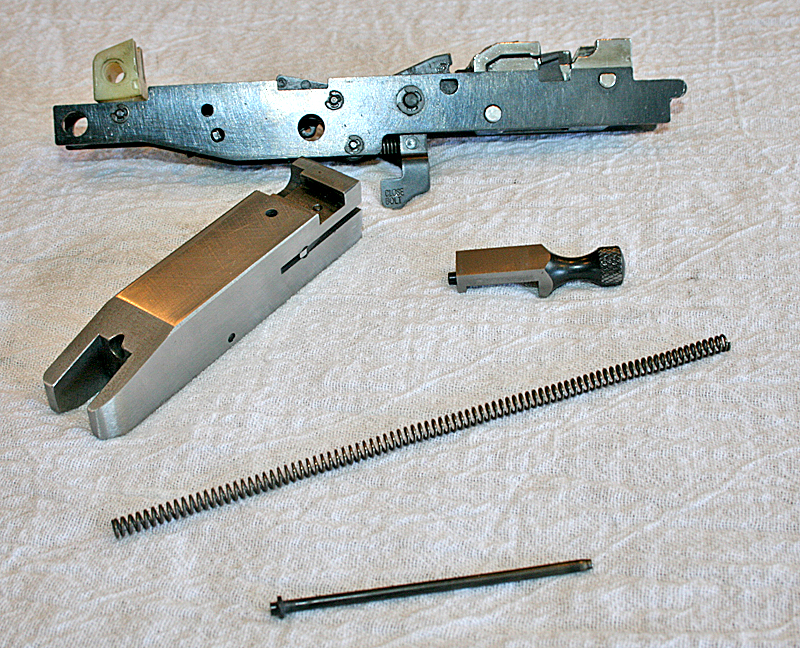
It all starts with a light alloy receiver that is completely open on the bottom.  The bolt is heavy steel and contains the firing pin and two extractors. Always nice to have two.  The recoil spring fits into a slot in the bolt and over a guide rod that fits into a slot in the receiver.  This is my only complaint about the gun.  Getting the bolt into the receiver without either bending the spring or shooting the guide rod across the room takes practice.  Other than that, take down for cleaning is a cinch.

The barrel is a fat, nearly bull, barrel with a tapper near the end.  No skinny, pencil barrel crap here.

A really great feature is the last shot hold open.  This guarantees you won't inadvertently dry fire the rifle, something that should be avoided with rimfires.  There is a difference in recoil on the last shot, just like an auto pistol.  Simply swap out the magazine, hit the bolt release, and fire away.  Why aren't they all like that?  Everywhere I look, I see neat features that I did not expect.


I had dismissed the 795 as just another cheep .22.  That was my mistake.  Quality wise, the 795 is above the crowd.  Fit and finish is great, considering the $159.00 price tag.  It is well engineered and well built.  I would put it on par with the 10-22 for much less cost.  All plastic parts are well made and do not give me the impression that they will snap anytime soon.

Simple and robust

One interesting thing is that the 795 is not available with a wood stock.  That's a shame, but the synthetic stock is quite well made.  It is glass reinforced and fits the rifle like a glove.  It sure beats the hell out of the plastic stock on my Savage 62.

Micro groove rifling is another feature that sets the 795 apart.  Marlin has long touted it micro groove barrels as superior in accuracy.  By most accounts, the 795 is very accurate.  Basically micro groove uses more grooves, but cut shallower.  Theory is that there is less drag on the bullet.  I don't know how much better it works.  All I know is the rifle hits what I aim it at.

One addition that I will be putting on it is the tech sights.  I've fallen in love with the sight picture on service rifles.  Since I cannot afford an M1 Garand, carbine, or  an AR, this will become my little carbine.


My initial shooting impression was very impressive.  I first ran American Eagle copper plated hollow points, which ran flawlessly.  Next, I tried some Remington Thunderbolts.  No issues.  Ok, so I really wanted this thing to jam.  On to the golden bullets by Remington.  Again, pop pop pop, no problems.  The only thing that would cause a failure to feed were Federal automatch, ironically.  For a new 22 to perform that well is impressive to me.  My Brother said that his 795 had a very rough feed ramp that he had to smooth out.  Mine was quite smooth, so I left it alone.  Again, attention to detail that I never expected from an under $200 gun.  Kudos to Remington for keeping this gun in production and keeping quality standards high.  Yes, Marlin is now part of freedom group.  I can't say that I am in favor of all these gun makers being absorbed by one big conglomerate, but I guess that is the way of the world.
Boyds Evolution SS Stock

Do I recommend the 795?  You bet.  It is way more than some cheap .22.  It is well engineered and well built.  With all the features on this little rifle they could charge more.  I'm glad they don't.